|
 |
 AichromBond AQ AichromBond AQ
AichromBond-SB
Aichrom Ion Exchange
Aichrom Chiral
Aichrom PAH
Aichrom Amino Acid
|
|
|
 |
|
| |
|
|
| PONA Analysis on AB-PONA Column |
| Introduction |
Gasoline, either naphtha, cracked or reformulated, contains large number of hydrocarbons including isomers. Because of complex compositions, the analysis of individual components is a challenging technique. ASTM D 5374 and D5374-92 give methods of detailed hydrocarbon analysis (DHA) for gasoline and other petrochemical applications. This specified DHA is done on high resolution capillary column, a 100% poly(dimethylsiloxane) column. Because of its specifically important role in DHA, this column is often called PONA column. Common PONA columns are either
0.20mm x 50m x 0.5um or 0.25mm x 100m x 0.5um.
Various software and methods have been developed for such PONA and DHA applications. There are two techniques for these applications. One is based on multi-dimensional GC, and other is based on high resolution chromatography. Both techniques use retention times of individual hydrocarbons to identify and quantify each composite separated. As the number of the composites of a gasoline can be as many as 500, the peak identification becomes very difficult and is very critical step for DHA. Often peak identification can be error. Intensive labor effort is then taken to manually correct errors in peak identification.
Among various software for ASTM D5134, a software called PONA developed by Beijing Chromtech Institute uses an algorithm of retention index to identify peaks. Because retention index is relatively insensitive to the variations from columns, instruments and methods, this software is able to automatically and correctly identify each peak with great confidence. Even though this algorithm improves accuracy of peak identification, it still requires minimum variations in column dimension, column retention time, column efficiency and column selectivity.
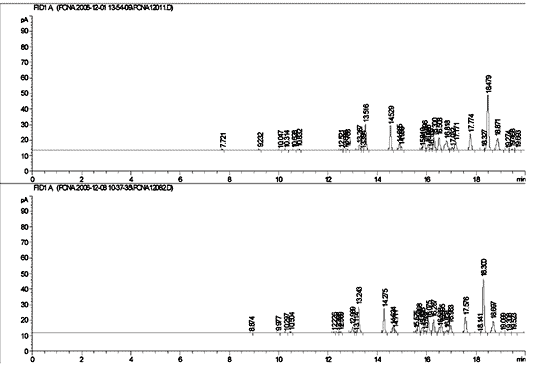
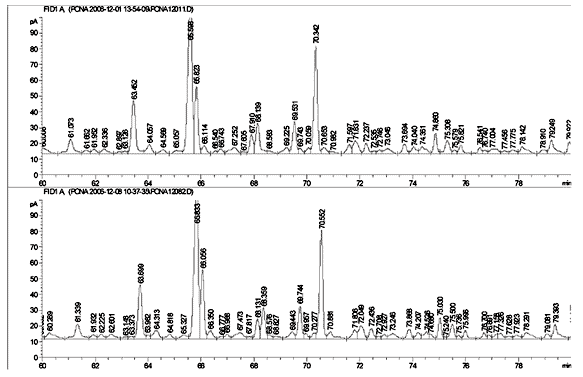
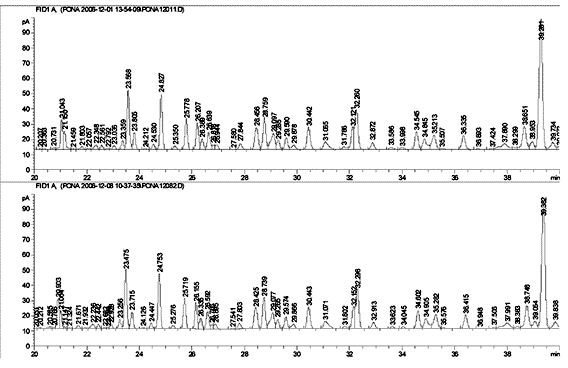
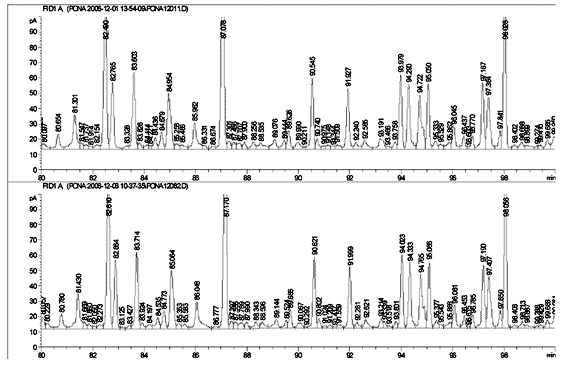
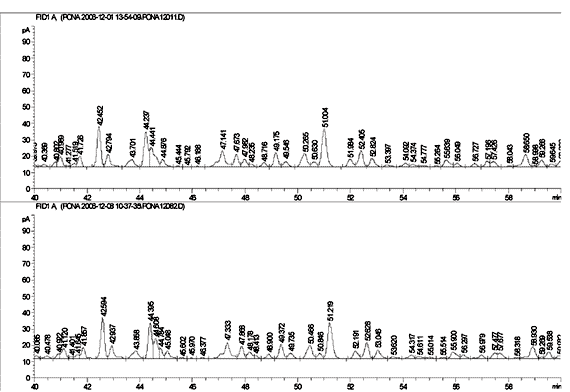
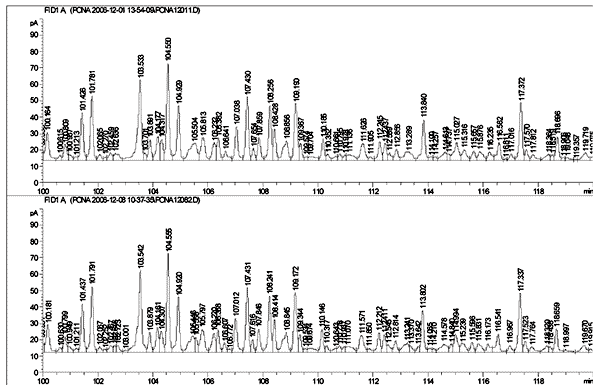
This application note describes a FCC gasoline application on an AB-PONA column. This AB-PONA column replicates the performances of HP-PONA column, an industrial fleet column, including column selectivity, column dimension and retention. Under the same instrumentation condition, the software PONA produces the same result as the one obtained from an HP-PONA column for this application.
|
|
| Experimental |
2.1 Column
The column used is an AB-PONA column, 0.20mm x 50m x 0.5um, coated with AB-1 stationary phase, part number 0120-5005, obtained from Abel Industries, Inc., Newark, DE 19713, USA. The column temperature limits are -60C to 325/350C. Prior to each run, column was conditioned at 250C for 4hr.
2.2 Instrument condition
Instrumentation conditions are listed in Table I.
| Table I the instrumentation conditions |
Gas Chromatography
|
Agilent 6890 GC with ALS |
Raw date acquisition
|
HP-Chemstation |
Inlet
|
250c, s/s, split flow 140ml/min |
Carrier
|
Nitrogen |
Column head pressure
|
99kpa varied |
Detector
|
FID, 300C |
Oven
|
35C 10min, 0.5c/min to 60C, 2C/min to 180C, 10+min |
Sample
|
A gasoline sample |
| Injection |
1ul |
|
|
|
2.3 Column retention time calibration
Constant pressure mode was used. Column head pressure was adjusted to have n-Pentane retention time around 9.75+-0.1min as holdup time prior to separation.
For a comparison, the analysis was repeated on an HP-PONA column at the same instrumentation condition. |
|
| |
| Software |
3.1 DHA and PONA analysis
PONA software from Beijing Chromtech Institute, Beijing, China was used in a PC with OS Microsoft 95 or above. It uses the following formula (1) to calculate the retention index of all individual peaks.
RIi = ((RTi-Rtref_Cn)/(Rtref_Cn+1-Rtref_Cn)+ Cn)*100 (1)
RIi: Retention index of composite i
RTi: Retention time of composite i
Cn : Reference peak of carbon n
Cn+1: Reference peak of carbon n+1
Rtref_Cn :Retention time of reference peak Cn
Rtref_Cn+1:Retention time of reference peak Cn+1
Retention time of reference peaks can be searched automatically based on empirical database
(2) Calculation of Octane Number
Two octane values defined by RON and MON are calculated as
i=N
RON = Cr + Fr∑ AiWi (2)
i=1
i=N
MON = Cm + Fm∑ BiWi (3)
i=1
Cr : given constant, RON
Fr : given correlation factor, ROM
Cm : given constant, MON
Fm : given correlation factor, MON
Ai : correlation coefficient of ith hydrocarbon, RON, listed in calibration table
Bi : correlation coefficient of ith hydrocarbon, MON, listed in calibration table
Wi : weight percentage of ith , measured by DHA
N : total number of peaks measured by DHA
(3) Calculation of Carbon/Hydrogen(C:H)ratio
i=N
C:H = ∑ (C:H)iWi (4)
i=1
(C:H)i : Carbon/Hydrogen of ith hydrocarbon
Wi :weight percentage of ith , measured by DHA
N : total number of peaks measured by DHA
(4) Calculation of Specific Gravity (D)
i=N
D = ∑ DiWi (5)
i=1
Di : Specific Gravity of ith hydrocarbon
Wi :weight percentage of ith , measured by DHA
N : total number of peaks measured by DHA
(5) Data Analysis:
Once the separation of each composite in a gasoline sample is completed, the raw data of DHA can be generated by HP Chemstation or similar data acquisition software. The raw data includes peak retention time, area and/or area percentage. The file format of the raw data file used in this PONA software is .D. After completion of the chromatography run, the PONA reads the raw data file, and automatically identify the reference peak from assigned one of three databases for three types of gasoline. Once the reference peaks are identified, the software can automatically calculate all physically and chemically values described in(1) to (4). The report file can be either printed or transfer to fit customized report generation.
|
|
| |
| Result |
|
| Conclusion |
Based on the above results and same instrumentation conditions used, it can conclude that both AB-PONA and
HP-PONA are essential identical and able to work for PONA applications with the PONA software to produce almost identical result. |
|
| |
| Order Guild |
| Table IV lists the suggested parts for PONA application. |
|
| Table IV Suggested parts for PONA analysis |
Item
|
Description |
P/N |
| 1 |
PONA software |
9901-PONA |
2
|
AB-PONA |
9902-PONA |
| 3 |
Gasoline Sample |
9903-PONA |
|
|
| |
| Other applications of AB-PONA column |
| Separations of natural gas, pesticides, and VOC. |
|
| |
| |
| |
| |
| |
| |
| |
|